

Full profile

Platform State: Harvey in Mid-2026
Harvey entered 2026 as the most widely deployed enterprise legal AI platform by firm count. In March 2026, the company raised $200 million at an $11 billion valuation, co-led by GIC and Sequoia — Sequoia's third consecutive lead round in the company. Harvey's annual recurring revenue reached $190 million in January 2026, up from $100 million in August 2025. Total funding raised now exceeds $1 billion.
The platform's adoption footprint, as Harvey discloses it: more than 100,000 lawyers across 1,300+ organizations, the majority of the AmLaw 100, over 500 in-house legal teams, and 50+ asset management firms across 60 countries. Clients disclosed by the company include NBCUniversal and HSBC.
Harvey was founded in 2022 by Winston Weinberg, a former O'Melveny securities litigator, and Gabe Pereyra, a former Google DeepMind and Meta research scientist. That origin shapes the product's design philosophy: it was built to handle the kind of complex, high-stakes legal work that large firm lawyers bill at $500+ per hour, not to serve general-purpose legal queries at volume.
| Metric | Figure | Source |
|---|---|---|
| Valuation (March 2026) | $11 billion | Harvey-disclosed / CNBC |
| Most recent funding round | $200M (March 2026) | Harvey-disclosed / CNBC |
| Total funding raised | >$1 billion | Harvey-disclosed |
| ARR (January 2026) | $190M | Harvey-disclosed / CNBC |
| Lawyers on platform | 100,000+ | Harvey-disclosed |
| Organizations | 1,300+ | Harvey-disclosed |
| AmLaw 100 penetration | Majority (exact count not disclosed) | Harvey-disclosed |
| In-house legal teams | 500+ | Harvey-disclosed |
| Countries | 60+ | Harvey-disclosed |
Core Product Suite: Assistant, Vault, Knowledge, and Workflow Agents
Harvey's platform is organized into four products that cover distinct segments of legal work. Understanding what each product is designed to do — and what it is not — is the first step in mapping Harvey's capabilities to a specific firm's workflow needs.
- Assistant handles question-and-answer tasks, legal drafting, and research within a conversational interface. It is the entry-point product and the one most attorneys encounter first. It draws on Harvey's model-agnostic architecture, which — based on community-sourced reporting rather than any official Harvey disclosure — deploys Claude, Gemini, and other frontier models depending on task type. Harvey has not published a definitive model roster.
- Vault is designed for bulk document review across large file sets. It operates in three modes: Review (tabular per-file answers across a document set), Ask (consolidated cross-document answers), and Deep Analysis (comprehensive cited reports). Vault syncs with iManage, SharePoint, and Box, and runs inside Microsoft Word, Outlook, and SharePoint. A mobile app launched in September 2025 with voice-to-prompt and document scanning; Box integration shipped in 2026.
- Knowledge provides cross-domain legal, regulatory, and tax research with citations. It is positioned for matters where research spans multiple practice areas or jurisdictions simultaneously.
- Workflow Agents handle multi-step task automation with conditionals, role-based permissions, and a no-code builder. In May 2026, Harvey launched 500+ pre-built, use-case-specific agents alongside a self-service Agent Builder for customer customization. Agents cover M&A, family law, capital markets, and tasks such as analyzing counterparty markups, comparing closing checklists, and identifying document issues. More than 25,000 custom agents now operate on the platform.
| Product | Primary Use Case | Key Integrations | Design Target |
|---|---|---|---|
| Assistant | Q&A, drafting, legal research | Word, Outlook, SharePoint | Attorney-facing conversational work |
| Vault | Bulk document review, cross-document synthesis | iManage, SharePoint, Box, Word | Large-scale diligence, contract review |
| Knowledge | Multi-domain legal/regulatory/tax research with citations | Platform-native | Complex research spanning jurisdictions |
| Workflow Agents | Multi-step automated workflows, conditionals | Agent Builder, platform APIs | Process automation at firm or matter scale |
Command Center: Enterprise Governance and Deployment Analytics
One of the most significant gaps in Harvey's enterprise proposition through early 2026 was the absence of a structured governance layer. Large firms deploying Harvey across practice groups had limited visibility into how the platform was actually being used — which attorneys were using which features, where adoption was stalling, and whether usage patterns matched the firm's investment rationale.
Harvey addressed this directly at its Forum NYC event on May 20, 2026, with the launch of Command Center. The product has three capability anchors:
- Usage analytics and peer benchmarking: Visibility into platform usage across practice groups, offices, and user cohorts, drawn from anonymized data across 1,500+ global Harvey deployments. Firms can compare their adoption patterns against peer organizations.
- Agentic analytics layer: Natural-language queries over a firm's own deployment data, enabling legal ops teams to generate governance reports without writing SQL or building custom dashboards.
- Intelligent recommendations and release tracking: Surfaces features that peer organizations have already enabled, helping firms identify adoption gaps relative to comparable deployments.
Command Center's design partners include Haynes Boone, Foley & Lardner, Clayton Utz, Rajah & Tann, and dentsu. As of this writing, it remains in waitlist and early-access status; general availability is planned for Q3 2026.
Simultaneously, Harvey announced a partnership with DeepJudge, which integrates a firm's institutional knowledge — past work product, precedent, and expertise — directly into Harvey workflows. This addresses what Harvey calls the 'context tax': the generic, lowest-common-denominator output produced when AI operates without access to a firm's prior work. For firms with mature document management systems and well-organized matter archives, the DeepJudge integration is potentially significant.
Security and Compliance Posture
For law firms and in-house legal teams, attorney confidentiality obligations under Model Rule 1.6 make the security architecture of any AI platform a threshold question, not a secondary consideration. Harvey's published security documentation covers the following commitments:
| Security Dimension | Harvey's Stated Posture | Verification |
|---|---|---|
| Certifications | SOC 2 Type II, ISO 27001, GDPR, CCPA | Annual audits by Schellman, NCC Group, Bishop Fox |
| Zero Data Retention (ZDR) | Contractually prohibits model providers from training on customer data; obligation passed to all subprocessors | Harvey security page; confirmed in May 2025 Red Clover Advisors interview |
| Data residency | US, EU/Switzerland, and Australia — including for subprocessors | Harvey security page |
| Workspace isolation | Logical separation; no cross-workspace access; penetration-tested | Harvey security page; Red Clover Advisors interview |
| Customer data control | Customers set retention periods and can delete data at any time; zero-day retention available | Harvey security page |
| Enterprise access controls | SAML SSO, audit logs, IP allow-listing, data lifecycle management | Harvey security page |
| Cloud infrastructure | Microsoft Azure | Harvey security page |
The zero data retention architecture is the most legally significant element for attorney confidentiality compliance. Harvey's contractual commitment — that neither Harvey nor its model providers will train on customer data — is passed down through contractual obligations to all subprocessors and external model providers. Customers can configure zero-day retention, meaning data is deleted within the day after output is produced.
Pricing Structure and Total Cost of Ownership
Harvey does not publish pricing. A demo request is required for any quote. All figures below are triangulated from industry sources — primarily Bind Legal's 2026 pricing analysis and AI Vortex's 2026 cost estimate — neither of which has access to Harvey's official contracts. These figures carry real uncertainty and should be treated as directional, not definitive.
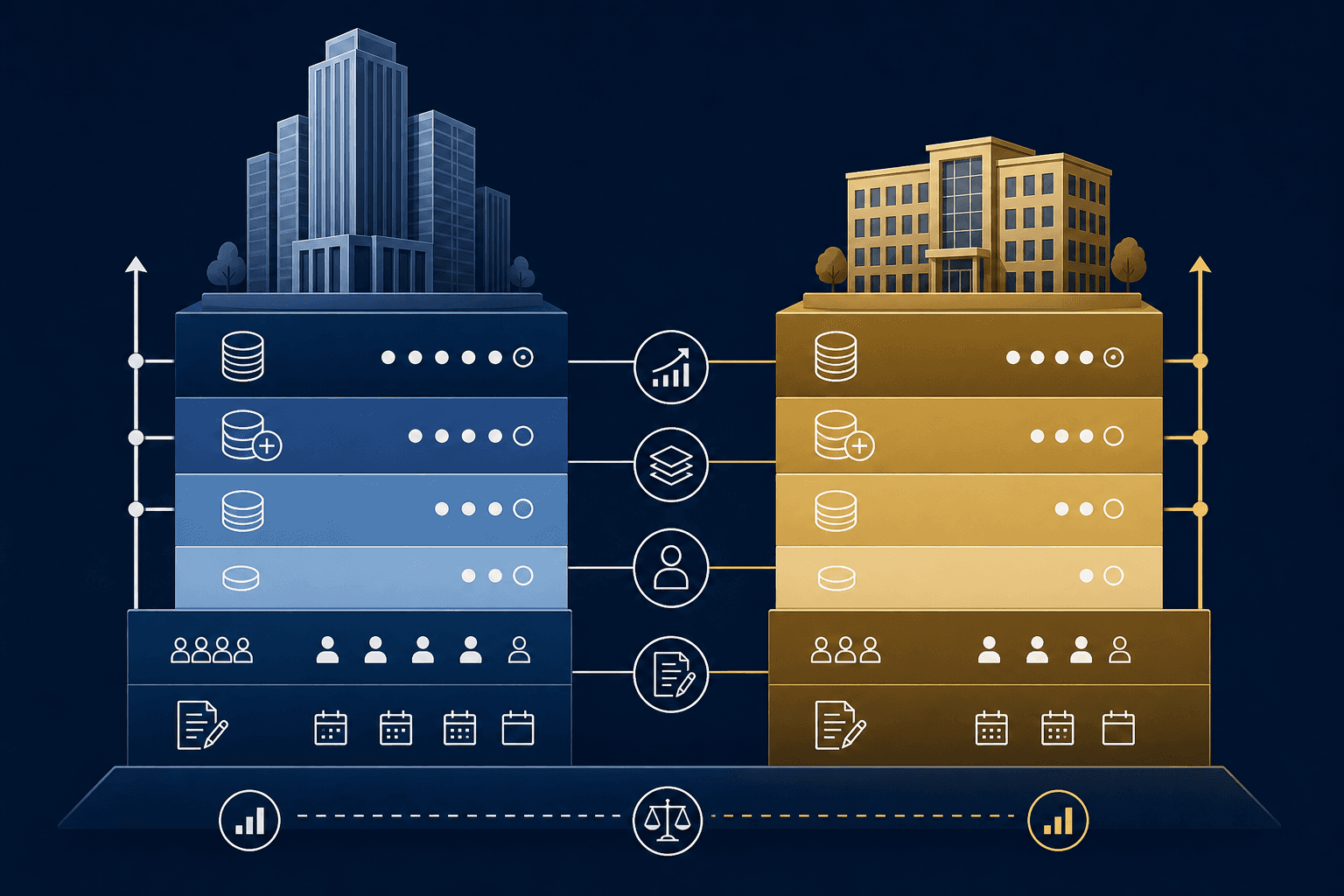
| Buyer Segment | Estimated Seat Cost / Month | Annual License (Est.) | Seat Minimum | Source |
|---|---|---|---|---|
| AmLaw 100 (200+ seats) | $100–$200/seat | $250K–$1M+ | 200+ (volume tier) | Bind (triangulated) |
| Mid-market firm (50–200 attorneys) | $1,200–$1,500/seat | $100K–$250K | 25–50 seats | Bind (triangulated) |
| Small/specialized firm (25–50 attorneys) | $1,500–$2,000+/seat | $50K–$100K | 25 seats | Bind (triangulated) |
| Corporate legal departments | Custom / not disclosed | Custom | Not disclosed | Harvey (no public pricing) |
Year 1 Total Cost of Ownership: 100-Attorney Mid-Market Deployment
License cost is only one component of Year 1 spend. Based on Bind's modeled TCO for a 100-attorney mid-market deployment, the full cost picture looks substantially different from the per-seat headline:
| Cost Component | Estimated Range | Notes |
|---|---|---|
| License (100 seats × 12 months) | $1.44M–$1.8M | At $1,200–$1,500/seat/month |
| Implementation services | $30K–$60K | Varies by integration complexity |
| Premium support | ~18% of license | ~$260K–$324K |
| Training (100 users) | $50K–$200K | $500–$2,000/user |
| Optional custom fine-tuning | $50K–$150K | If required for specialized workflows |
| Year 1 TCO (estimated) | $1.97M–$2.25M+ | Bind model; not official Harvey figures |
Renewal Escalation and Negotiation Levers
Renewal escalation is a significant risk in Harvey contracts. Industry sources report renewal increases of 10–25% without contractual caps — meaning a $1.5M Year 1 contract could reach $1.65M–$1.875M at renewal without any product change. Buyers should negotiate the following before signing:
- Renewal rate cap: Push for a contractual cap of 5–7% on annual renewal increases.
- Multi-year discount: Multi-year commitments can yield 10–20% discounts on the license fee.
- Pilot extension: For large deployments, negotiate a 4–6 month pilot extension before committing to a full-term contract.
- Competing quotes: Obtaining quotes from CoCounsel, Legora, or GC AI creates negotiating leverage even if Harvey is the preferred platform.
- Itemized quote: Request a line-item breakdown of license, implementation, support, and training — bundled quotes obscure the true cost structure.
The Legal Agent Benchmark (LAB): What the Evidence Actually Shows
In May 2026, Harvey published the Legal Agent Benchmark (LAB), an open-source framework for measuring AI agent performance on legal work. It is the most structurally rigorous public attempt to date to measure what legal AI agents can actually do on the kind of work law firms delegate — and its initial results are more candid about current AI limitations than most vendor communications.
How LAB Works
Each LAB task is structured as a partner-to-associate instruction (approximately 50 words), a closed-universe client matter file system, a required reviewable work product output, and expert rubric grading. The benchmark includes 1,250 tasks across 24 legal practice areas, evaluated against more than 75,000 expert-written rubric criteria.
The defining feature is all-pass grading: a task is marked complete only if every rubric criterion passes. There is no partial credit. As Harvey's own framing puts it, a deal-team report that identifies eight of ten risks is not 80% useful — it is materially incomplete. A single M&A change-of-control task in LAB has 57 rubric criteria covering nine legal issues.
Initial Results
The initial LAB results are striking: under all-pass grading, frontier models complete fewer than 10% of tasks end-to-end.
| Model | LAB All-Pass Score | Cost per Task | Avg. Latency | Strongest Practice Areas |
|---|---|---|---|---|
| Claude Opus 4.7 | 7.1% | ~$50.90 | ~22 minutes | Corporate transactions, funds |
| Claude Sonnet 4.6 | 5.4% | Not disclosed | Not disclosed | Privacy, tax, private-client |
| Claude Opus 4.6 | 4.2% | Not disclosed | Not disclosed | Not disclosed |
| GPT-5.5 | 2.1% | Not disclosed | Not disclosed | Regulated/emerging-company categories |
| Gemini 3.5 Flash | 0.8% | Not disclosed | Not disclosed | Not disclosed |
How Buyers Can Use LAB in Procurement
Despite its Harvey origin, LAB's methodology is useful as a vendor evaluation framework. As independent legal tech analyst Bob Ambrogi noted, law firms evaluating competing products could ask each vendor to report LAB performance on specific practice areas — rather than relying on demos or vendor-curated use cases. If a competing vendor claims superior performance in, say, M&A due diligence or regulatory compliance, asking them to run their agent against LAB's M&A or regulatory tasks provides a structured comparison basis.
The strongest behavioral predictor of all-pass success in LAB is self-correction: agents that validate and revise after initial drafting improve all-pass scores by 1.5 points on average. When evaluating any legal AI agent — Harvey or otherwise — ask whether the system implements a validate-then-revise loop, and whether that behavior is documented in the vendor's architecture.
Enterprise Deployment Considerations
The licensing cost is the most visible line item in a Harvey procurement decision, but it is not the most consequential variable in whether the deployment succeeds. Firms that underinvest in the operational layer — change management, training, governance, and ongoing adoption tracking — consistently see lower utilization rates and weaker ROI, regardless of the platform.
- Implementation complexity scales with firm size. A 50-attorney deployment with a single practice focus is meaningfully simpler than a 300-attorney deployment spanning litigation, corporate, and tax. The $30K–$60K implementation estimate from Bind reflects mid-market complexity; large-firm deployments with multiple integrations (iManage, SharePoint, custom workflows) will land higher.
- Change management is consistently underestimated. Attorneys adopt AI tools when they see workflow benefit, not when IT deploys them. Firms that designate practice-group champions and run structured adoption programs see materially better utilization than those that treat deployment as a software rollout.
- Harvey Academy provides on-demand training resources. Confirm during contract negotiation what is included in the license versus what is billed separately as training services. The $500–$2,000/user training estimate from Bind suggests significant variation in how firms structure this.
- Command Center is the governance layer — but it is not GA yet. Until Command Center reaches general availability (planned Q3 2026), firms will need to build their own usage tracking and governance reporting. This is a real operational gap for large deployments.
- Negotiate a pilot extension for large deployments. A 4–6 month pilot before full commitment gives the firm time to validate utilization rates, identify workflow gaps, and negotiate from a position of data rather than projection.
Fit Assessment by Organization Type
Harvey's pricing structure creates materially different value propositions depending on the buyer's size and workflow profile. A single fit assessment does not apply across all organization types.
| Organization Type | Fit Assessment | Key Rationale | Primary Caution |
|---|---|---|---|
| AmLaw 100 firm (200+ attorney deployment) | Strong fit | Volume economics bring per-seat cost to $100–$200/month. Platform breadth matches complex, multi-practice-area needs. Majority of AmLaw 100 already deployed. | Governance layer (Command Center) not yet GA. Negotiate renewal caps; renewal escalation risk applies at any seat count. |
| Mid-market law firm (50–200 attorneys) | Conditional fit — requires rigorous TCO modeling | Platform capability is strong for M&A, diligence, and complex litigation support. But per-seat pricing is 6–10x higher than AmLaw 100 rates. | Year 1 TCO can exceed $2M for 100 attorneys. Must model 3-year cost with renewal escalation. Competing tools may offer better TCO for narrower workflow needs. |
| In-house enterprise legal team (M&A/diligence-heavy) | Strong fit for deal-intensive teams | Vault's bulk document review and Knowledge's cross-domain research align well with transaction and diligence workflows. DeepJudge integration adds institutional knowledge grounding. | Pricing for in-house teams is custom and not publicly triangulated. Ensure data residency requirements are met for your jurisdiction. |
| In-house legal team (contract-only or high-frequency general legal tasks) | Weaker fit | Harvey's architecture and pricing are optimized for complex, high-value work. For contract-only teams or high-volume routine queries, purpose-built tools offer better TCO. | Evaluate Spellbook (Word-native contracts) or a CLM-integrated tool before committing to Harvey's pricing structure for this workflow profile. |
Competitive Alternatives by Use Case
This section is not a comparison article. It identifies three alternatives relevant to buyers whose needs or budgets fall outside Harvey's core fit profile — not as substitutes for a full evaluation of each platform.
| Platform | Estimated Pricing | Primary Strength | Best Fit For | Key Limitation vs. Harvey |
|---|---|---|---|---|
| CoCounsel (Thomson Reuters) | ~$225/seat/month (bundled with Westlaw) | Deep Westlaw integration; citation-grounded legal research | Research-primary workflows; firms already on Westlaw | Narrower product breadth; weaker for bulk document review and multi-step agent workflows |
| Legora | Not publicly disclosed | European-first architecture; stronger DACH/Nordic data residency | EU-based firms or firms with significant EU data residency requirements | Smaller deployment footprint; less mature agent ecosystem than Harvey |
| Spellbook | ~$99–$199/seat/month | Word-native contract drafting and review; low friction adoption | Mid-market and in-house teams with contract-primary workflows | Narrowly scoped to contracts; not a platform for research, diligence, or multi-step agents |
Buyer Evaluation Checklist
The following checklist converts this profile's analysis into a structured procurement process. Work through each item before signing a Harvey contract.
Pricing and Contract Terms
- Request an itemized quote separating license, implementation, support, and training costs.
- Confirm the seat minimum for your deployment size and whether partial-seat-count pricing is available.
- Negotiate a contractual renewal rate cap — target 5–7% annual increase.
- Request a multi-year discount (10–20% is reported as achievable).
- Negotiate a 4–6 month pilot extension before the full-term commitment if this is your first enterprise AI deployment.
- Obtain at least one competing quote (CoCounsel, Legora, or GC AI) to establish negotiating leverage.
- Model Year 3 cost including renewal escalation before signing a multi-year contract.
Security and Compliance Validation
- Request a copy of Harvey's Data Processing Agreement and confirm ZDR is contractually binding on named model providers.
- Confirm data residency applies to your jurisdiction (US, EU/Switzerland, or Australia) for all subprocessors in your processing chain.
- Confirm SOC 2 Type II and ISO 27001 certifications are current; request the most recent audit report summary.
- Verify that workspace isolation has been independently penetration-tested and ask for the most recent test date.
- Confirm your firm's bar jurisdiction's ethics guidance on AI tool use is satisfied by Harvey's ZDR and confidentiality architecture.
Governance and Deployment Readiness
- Confirm Command Center's GA timeline and whether it is included in your contract scope or priced separately.
- Clarify what governance and usage reporting is available before Command Center reaches GA.
- Confirm the DeepJudge integration scope if institutional knowledge grounding is a priority — and what document management systems it supports.
- Identify internal change management resources before deployment, not after.
- Confirm what Harvey Academy training is included in the license versus billed separately.
Capability Validation
- Ask Harvey to provide LAB all-pass scores for the specific practice areas most relevant to your firm's work — do not rely on aggregate scores.
- Ask competing vendors to run the same LAB practice-area tasks for direct comparison.
- During the demo, test Vault on a representative document set from your actual workflows — not Harvey's curated examples.
- Ask which underlying models are deployed for your primary use cases and how model changes are communicated under the contract.
- If Agent Builder is a priority, confirm whether the 500+ pre-built agents cover your practice areas or whether custom agent development will be required — and at what cost.
Comments
Join the discussion with an anonymous comment.