
Tracker Record: Document Identification and Authority Level
| Field | Value |
|---|---|
| Full Citation | NYSBA Task Force on Artificial Intelligence, Report and Recommendations (April 6, 2024), adopted by the NYSBA House of Delegates |
| Issuing Body | New York State Bar Association (NYSBA) Task Force on Artificial Intelligence |
| Adopting Body | NYSBA House of Delegates |
| Date Adopted | April 6, 2024 |
| Instrument Type | Task force report with adopted recommendations |
| Authority Level | Non-binding guidance — not a formal ethics opinion, not a rule amendment, not citable as binding authority |
| Status | In effect as adopted guidance |
| Jurisdiction | New York State |
| Primary Source | NYSBA Task Force Report PDF (nysba.org) |
| Last Confirmed | June 3, 2026 |
Scope: What the 90-Page Report Covers
The NYSBA Task Force Report runs approximately 90 pages and is organized into four substantive sections: an overview of the evolution of AI and generative AI; a benefits-and-risks analysis; a section on the legal profession's relationship to AI (including an ethical impact subsection); and a legislative overview with formal recommendations. The guidelines themselves appear on pages 57–60 and map specific conduct rules to AI-related obligations.
The report was issued against a backdrop of limited attorney adoption. At the time of issuance, a LexisNexis survey cited in the report found that only 43% of attorneys used or planned to use AI tools as part of their work — establishing the adoption baseline against which subsequent growth has been measured.
- Evolution of AI and generative AI: technical background on how large language models and generative AI systems function
- Benefits and risks: efficiency gains, access-to-justice potential, and documented risks including hallucination, bias, and data exposure
- Legal profession impact: how AI affects attorney workflows, with a dedicated ethical impact subsection covering seven areas mapped to the New York Rules of Professional Conduct
- Legislative overview and recommendations: survey of existing AI-related legislation and the Task Force's five formal recommendations to the House of Delegates
- AI and GenAI guidelines (pp. 57–60): per-rule guidance citing 14 specific Rules of Professional Conduct
Ethical Obligations Mapped to New York Rules of Professional Conduct
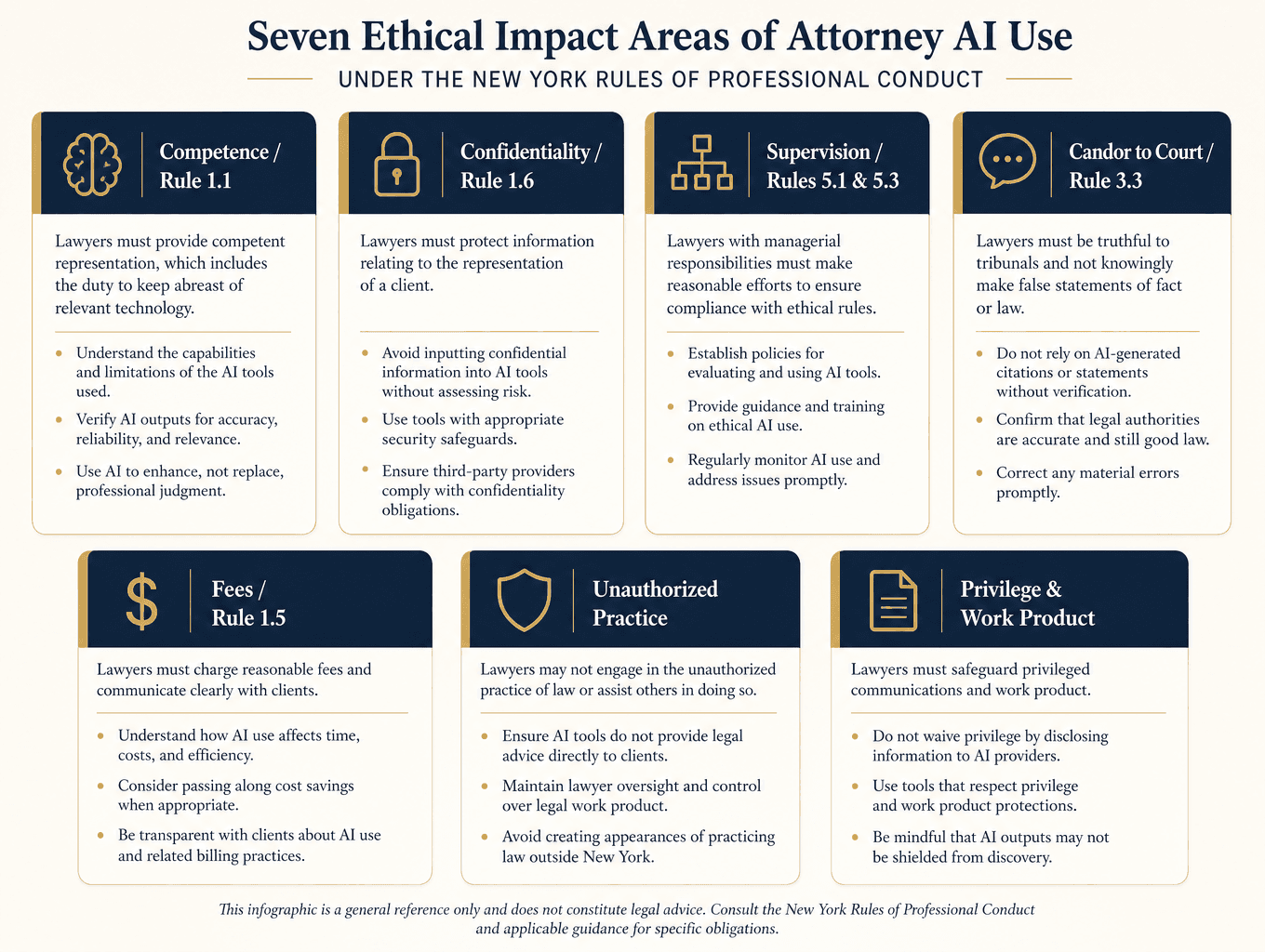
The report identifies seven ethical impact areas and maps each to specific New York Rules of Professional Conduct. The guidelines section (pp. 57–60) cites 14 rules in total, including Rule 6.1 on pro bono — where the report notes that AI may enable attorneys to substantially increase the scope of pro bono services they can offer. The seven primary areas are detailed below.
| Ethical Impact Area | New York Rule(s) | How the NYSBA Report Frames the Obligation |
|---|---|---|
| Duty of Competence | Rule 1.1 | Attorneys must understand AI tools and their limitations before deploying them. The report states that a refusal to use technology that makes legal work more accurate and efficient may itself constitute a failure of competent representation. |
| Duty of Confidentiality and Privacy | Rule 1.6 | Attorneys must vet vendor data-handling practices before inputting client information into any AI system. The report identifies that privileged information and attorney work product can be exposed through GenAI tool use if vendor terms are not carefully reviewed. |
| Duty of Supervision | Rules 5.1, 5.3 | Supervising attorneys bear responsibility for subordinates' AI use. Attorneys who delegate AI-assisted tasks remain independently obligated to observe the ethical rules; delegation does not transfer the ethical obligation. |
| Unauthorized Practice of Law | N/A (statutory) | AI tools must not be used in ways that facilitate unauthorized practice, including through automated legal advice to non-clients without attorney oversight. |
| Attorney-Client Privilege and Work Product | N/A (evidentiary doctrine) | The report provides examples (pp. 34–35) of how privilege can be waived when using GenAI tools, including through exposure of confidential communications in tool inputs. |
| Candor to the Court | Rule 3.3 | All AI-generated output — particularly citations and legal authority — must be verified by the attorney before reliance. The report specifically calls out the risk of hallucinated citations in filed documents. |
| Fees | Rule 1.5 | AI-related surcharges must be disclosed in engagement letters. Efficiency savings achieved through AI use must be reflected in billing — attorneys may not charge full hourly rates for time AI has materially reduced. |
Five Formal Recommendations to the House of Delegates
The Task Force made five distinct formal recommendations to the NYSBA House of Delegates. Each maps to a separate institutional action. They are not interchangeable and should not be collapsed into a single directive.
- Adopt AI/GenAI guidelines and establish a standing committee. The NYSBA should formally adopt the guidelines set out in the report and establish a dedicated section or standing committee tasked with regularly updating them as AI technology evolves. This recommendation led to the creation of the NYSBA Committee on Artificial Intelligence and Emerging Technologies (AIETC) as the successor body to the Task Force.
- Educational initiatives. The NYSBA should prioritize educating judges, lawyers, law students, and regulators on AI technologies. The report specifically emphasizes education on "closed system" AI — tools that do not store user queries as training data — as a category attorneys need to understand when evaluating confidentiality risk.
- Address unregulated risks. Legislatures and regulators should identify and address AI-related risks not covered by existing laws. This recommendation is directed outward — to legislative and regulatory bodies — rather than to the bar association itself.
- Revise the Rules of Professional Conduct to include AI competence. The Task Force recommended including AI competence in the Preamble to the New York Rules of Professional Conduct and amending Comment 8 to Rule 1.1 to expressly require that attorneys stay informed about AI technologies. As of June 2026, this amendment has not been adopted.
- Tailored AI governance. AI regulations should be developed with specificity to the risks and sectors involved, balancing the need for local and global regulatory cooperation rather than applying uniform rules across all AI use cases.
Notable Gaps in the Report
Understanding what the report does not cover is as important as understanding what it does. The following topics are outside the scope of the Task Force Report, and practitioners seeking guidance on them must look to other sources.
- Agentic AI systems: the report does not address AI agents that take autonomous actions, execute multi-step tasks, or interact with external systems on behalf of attorneys or clients.
- Tool-vetting standards and approved vendor lists: the report does not establish criteria for evaluating specific AI products or identify any tools as approved or prohibited for attorney use.
- Malpractice insurance implications: the report does not address how AI use affects professional liability coverage, policy terms, or insurer disclosure requirements.
- Deepfakes and AI-fabricated evidence: the report does not address the use of AI to generate or detect fabricated audio, video, or documentary evidence in legal proceedings.
- Mandatory AI continuing legal education: the report does not recommend or establish any standalone AI-specific CLE requirement for New York attorneys.
New York's Layered AI Compliance Framework: How This Instrument Fits
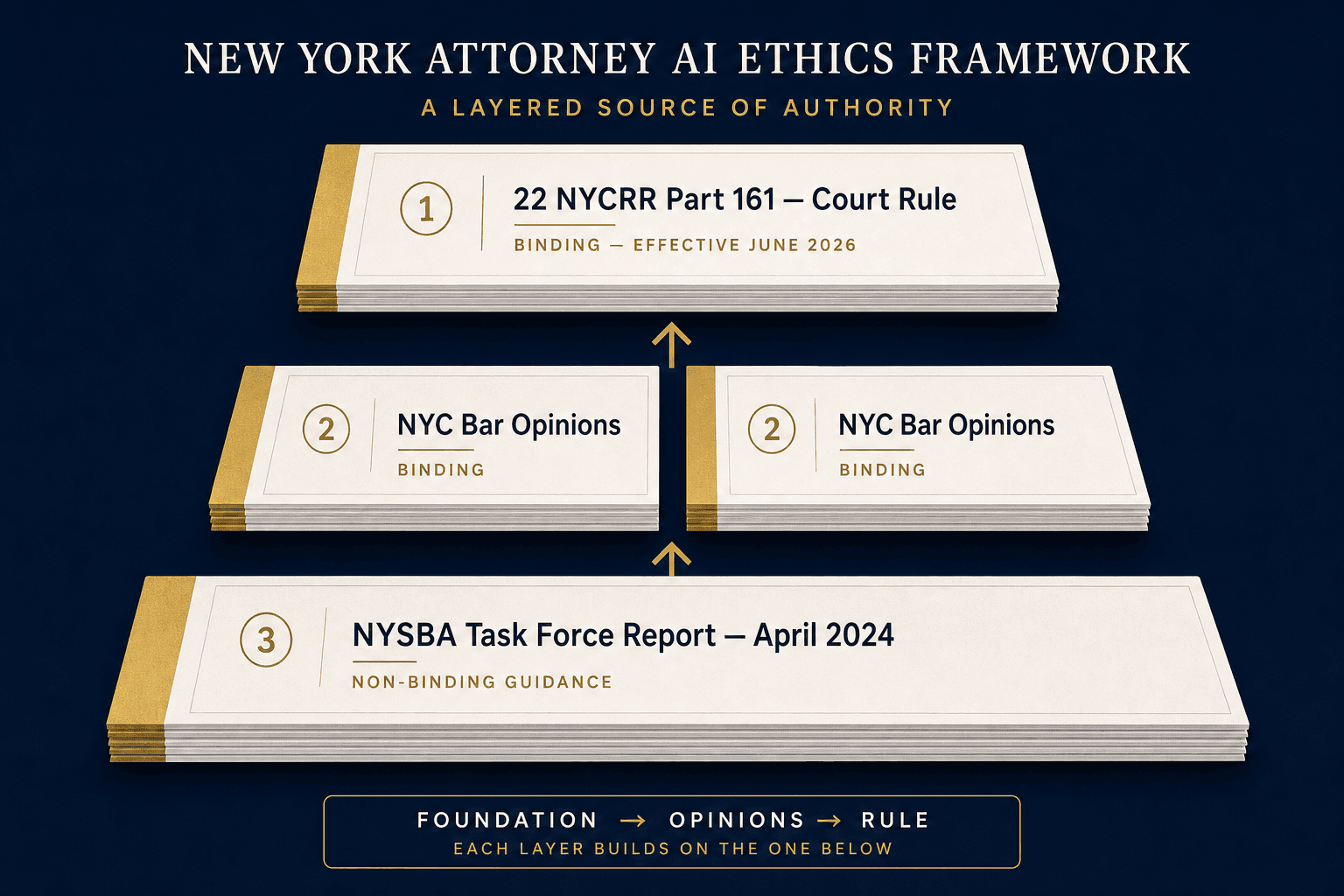
The NYSBA Task Force Report is the earliest and most comprehensive of the instruments in New York's AI ethics framework, but it is not the most authoritative. New York attorneys face a layered set of obligations that combine non-binding guidance with binding formal ethics opinions and a binding court rule. The instruments must be read together, not in isolation.
| Instrument | Issuing Body | Date | Binding? | Scope |
|---|---|---|---|---|
| NYSBA Task Force Report and Recommendations | NYSBA (statewide bar association) | April 6, 2024 | No — non-binding task force report adopted by House of Delegates | Seven ethical impact areas; 14 Rules of Professional Conduct; five recommendations including engagement-letter disclosure and Rule 1.1 Comment 8 amendment |
| NYC Bar Formal Opinion 2024-5 | NYC Bar Association (separate body from NYSBA) | August 7, 2024 | Yes — formal ethics opinion binding on NYC Bar members; persuasive for all NY practitioners | Generative AI in the practice of law; cites 20+ rules; explicitly declines to recommend rule amendments (diverging from NYSBA report) |
| NYC Bar Formal Opinion 2025-6 | NYC Bar Association | December 22, 2025 | Yes — formal ethics opinion | AI recording, transcription, and summarization of client conversations; requires informed client consent |
| 22 NYCRR Part 161 | New York State Courts (Office of Court Administration) | Adopted March 25, 2026; effective June 1, 2026 | Yes — binding court rule | Certification that filed documents contain no AI-fabricated content; disclosure of AI use is NOT required under Part 161 |
| Senate Bill S2698 | New York State Senate | Pending | Not yet in effect | Would require disclosure of AI use plus human-review certification for AI-drafted civil filings; pending Senate Judiciary Committee; goes further than Part 161 |
The relationship between the NYSBA report and NYC Bar Formal Opinion 2024-5 illustrates how the two instruments interact and diverge. The NYC Bar opinion cites the NYSBA report in a footnote but explicitly declines to follow its recommendation to amend the Rules of Professional Conduct, stating that rule amendments are premature given the pace of technological change. The two instruments reach broadly similar conclusions on attorney obligations under existing rules, but they are issued by different bodies — the NYSBA is the statewide bar association; the NYC Bar is the separate New York City Bar Association — and they carry different authority.
CLE Implications for New York Attorneys
New York has no standalone AI-specific continuing legal education requirement as of June 2026. The NYSBA Task Force Report recommended educational initiatives but did not recommend a mandatory AI CLE credit category, and no such requirement has been adopted.
Primary Source, Last Confirmed Date, and Editorial Disclaimer
The primary source for this tracker entry is the NYSBA Task Force on Artificial Intelligence Report and Recommendations PDF, available at nysba.org. Readers should verify the current text of the report and any subsequent updates from the NYSBA Committee on Artificial Intelligence and Emerging Technologies (AIETC) — the standing committee established as the successor to the Task Force — directly at nysba.org before relying on this summary for compliance purposes.
Comments
Join the discussion with an anonymous comment.