
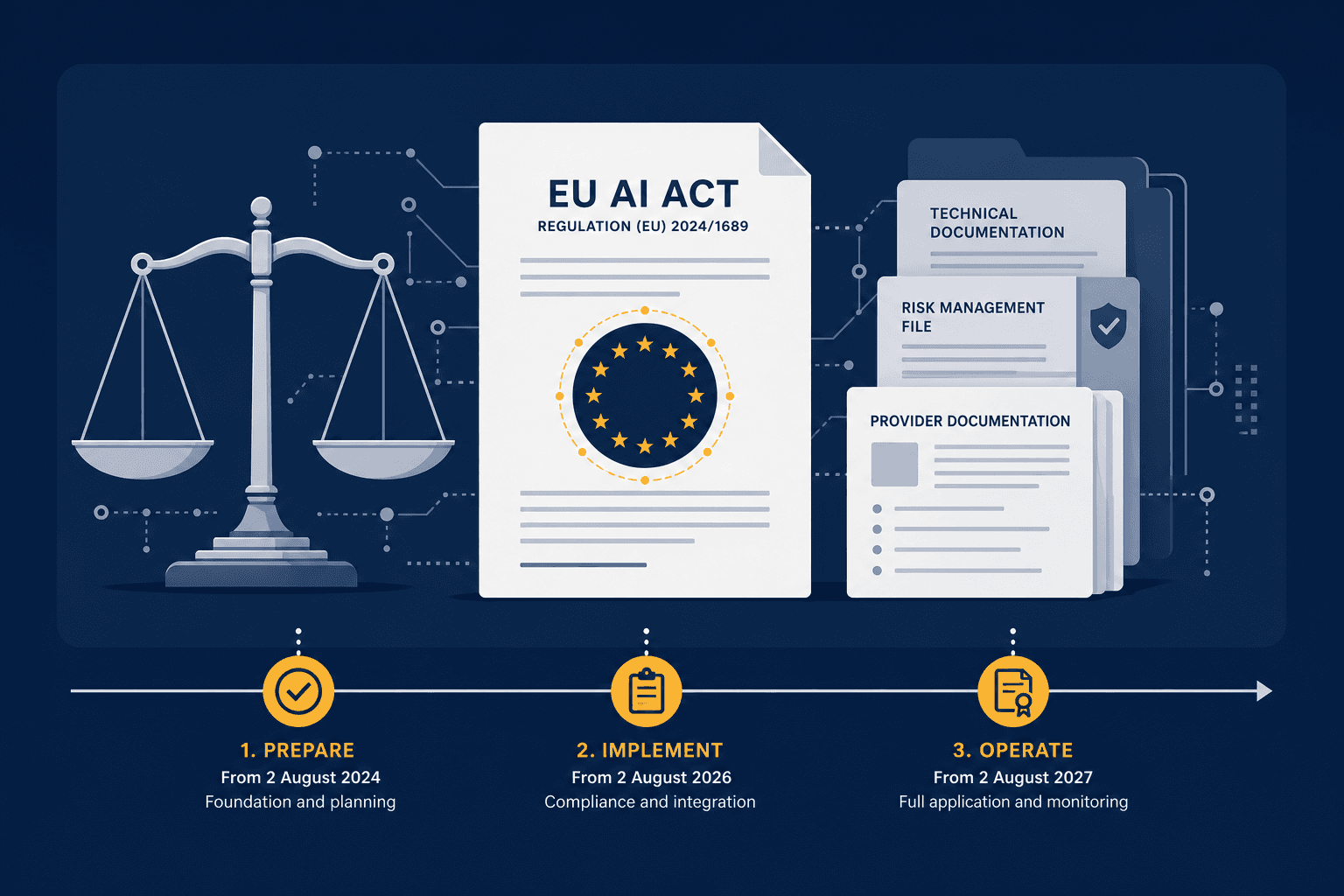
The EU AI Act is now a live compliance instrument, not a future regulatory horizon. For legal organizations, the operative question in mid-2026 is not whether the Act applies, but which obligations apply now, which have been deferred, and what the Annex III 'administration of justice' classification means for the AI tools already running in their practices. The May 2026 Digital Omnibus agreement has reset the Annex III enforcement deadline to December 2, 2027 — but several obligations are already in force and require attention this year.
This entry is structured as a deployer's reference guide for law firms and in-house legal departments. It maps the current obligation landscape, explains the contested high-risk classification question for legal AI tools, and provides a phased compliance timeline grounded in the confirmed Omnibus agreement.
Scope and Extraterritorial Reach: Which Legal Organizations Are Covered
The EU AI Act follows a jurisdictional model closely analogous to the GDPR. It applies not only to organizations established within the EU but also to those outside the EU whose AI systems are placed on the EU market or whose AI outputs are used in the EU. For legal organizations, this creates meaningful extraterritorial exposure.
Under this framework, a US-headquartered law firm that uses a legal research AI platform to advise EU-based clients — where the AI output informs legal work performed for those clients — is within scope. The same applies to an in-house legal department at a multinational corporation whose EU operations are supported by AI-assisted contract review or compliance monitoring tools.
- EU-established law firms and legal departments: fully in scope regardless of tool origin.
- Non-EU firms placing AI systems on the EU market: in scope as providers or deployers depending on their role.
- Non-EU firms whose AI outputs are used in the EU: in scope where the output influences decisions affecting EU persons or EU legal proceedings.
- Non-EU firms with no EU operations and no EU-client exposure: likely outside scope, but the boundary depends on facts and remains subject to national enforcement interpretation.
Provider vs. Deployer: Where Most Legal Organizations Stand — and When the Line Shifts
Article 3 of the EU AI Act draws a foundational distinction between providers — those who develop or place an AI system on the market — and deployers — those who use an AI system in a professional capacity. This distinction determines the scope and weight of applicable obligations. For most law firms and legal departments, the operative role is deployer.
A firm that licenses Harvey, Thomson Reuters CoCounsel, Lexis+ AI, or a comparable third-party legal AI platform without substantially modifying the underlying system is a deployer. Provider obligations under Articles 16 through 25 — which include quality management systems, technical documentation, conformity assessments, and EU database registration — do not apply to that firm. Deployer obligations under Article 26 apply instead, and they are meaningfully lighter.
The line can shift. A firm that substantially modifies a third-party AI system, integrates it into a proprietary workflow in ways that alter its intended purpose, or places a rebranded system on the market under the firm's own name may be reclassified as a provider. That reclassification carries significantly heavier obligations.
| Role | Typical Legal Organization Profile | Applicable Obligations |
|---|---|---|
| Deployer | Law firm or in-house legal department licensing a third-party legal AI tool without substantial modification | Article 26 deployer obligations: human oversight, log retention, incident reporting, employee notification, instructions-for-use compliance |
| Provider | Legal tech vendor developing and placing a legal AI system on the EU market | Articles 16–25: quality management, risk management, technical documentation, conformity assessment, EU database registration |
| Reclassified as Provider | Firm that substantially modifies, rebrands, or puts a third-party AI system on the market under its own name | Full Articles 16–25 provider obligations apply — the deployer shield is lost |
Annex III Point 8(a) and the 'Administration of Justice' Gray Zone for Legal AI Tools
Annex III lists the use-case categories that trigger high-risk classification under Article 6(2). Point 8 covers the administration of justice and democratic processes. Point 8(a) reads:
AI systems intended to be used by a judicial authority or on their behalf to assist a judicial authority in researching and interpreting facts and the law and in applying the law to a concrete set of facts, or to be used in a similar way in alternative dispute resolution.
The text is written around judicial authorities and bodies acting on their behalf. This creates genuine ambiguity for private legal practice. A court-appointed expert using AI to assist a judge in fact-finding is clearly within scope. A private law firm using a legal research platform to prepare a client's brief is a harder case — and the answer depends on whether the tool materially influences legal decision-making in a way the text contemplates.
The ambiguity is compounded for ADR tools. Point 8(a) explicitly includes alternative dispute resolution, which brings arbitration-support and mediation-assistance AI tools into the scope of the provision — though again the question of whether a specific deployment is high-risk turns on the materiality of the AI's role in the outcome.
The Article 6(3) Materiality Exception: A Genuine and Significant Carve-Out
Article 6(3) provides that an AI system meeting an Annex III use-case description is nonetheless not considered high-risk if it does not pose a significant risk of harm to health, safety, or fundamental rights — including by not materially influencing the outcome of decision-making. Four criteria can establish that the system does not pose such risk:
- The system is intended to perform a narrow procedural task.
- The system is intended to improve the result of a previously completed human activity.
- The system is intended to detect decision-making patterns without replacing or influencing the completed human assessment, without proper human review.
- The system is intended to perform a preparatory task to an assessment relevant to the Annex III use cases.
For legal AI tools, the fourth criterion — the 'preparatory task' exception — is the most practically significant. A legal research platform that surfaces relevant case law for an attorney to review and apply is arguably performing a preparatory task; the attorney, not the AI, makes the legal assessment. A contract review tool that flags potentially problematic clauses for attorney review, without making the final determination, may similarly qualify.
However, the Article 6(3) exception is not self-executing. The provider of the AI system must document the assessment that the system does not pose a significant risk before placing it on the market. Deployers relying on this exception should request that documentation from their AI vendors as part of due diligence.
| Legal AI Tool Type | Annex III 8(a) Relevance | Article 6(3) Exception Plausibility | Key Variable |
|---|---|---|---|
| Legal research platform (case law retrieval) | Potentially within scope if used in judicial or ADR contexts | High — preparatory task, improves prior human activity | Does the AI apply law to facts, or surface material for attorney review? |
| Contract review / clause flagging | Lower — typically private commercial context, not judicial authority | High — narrow procedural task, preparatory to attorney assessment | Does the AI make binding determinations or flag for human review? |
| ADR support / arbitration analysis tools | Explicitly within scope of 8(a) text | Moderate — depends on whether output directly conditions the award | Does the arbitrator retain full decision-making authority? |
| Individual risk scoring / client profiling | Potentially within scope; profiling triggers automatic high-risk | None — profiling AI is always high-risk regardless of 6(3) | Whether the system processes personal data to assess individual characteristics |
Article 26 Deployer Obligations: What Legal Organizations Must Do
For law firms and legal departments that deploy high-risk AI systems as deployers under Article 26, the EU AI Act imposes a concrete and structured set of obligations. These are meaningfully lighter than the provider obligations under Articles 16 through 25, but they are not nominal.
- Use the system per provider instructions: Deployers must implement the AI system in accordance with the provider's instructions for use and take appropriate technical and organizational measures to monitor its operation.
- Assign competent human oversight: A designated person with the necessary competence, training, authority, and support must be assigned responsibility for human oversight of the high-risk AI system.
- Retain automatically generated logs for at least six months: Deployers must preserve the logs automatically generated by the AI system for a minimum of six months, unless EU or national law requires longer retention.
- Report serious incidents and suspend use: If a serious incident is identified — an incident that results or could result in death, serious harm to health, property, or fundamental rights — the deployer must immediately inform the provider and the relevant national market surveillance authority, and must suspend use of the system.
- Notify employee representatives and affected employees: Before deploying a high-risk AI system that will be used in relation to employees, deployers must inform employee representatives and the employees who will be subject to the system.
- Conduct a Fundamental Rights Impact Assessment (FRIA): This obligation applies to deployers that are public bodies or private entities providing public services, or that deploy credit-scoring or life and health insurance pricing AI systems. Most private law firms are not subject to the FRIA requirement, but legal departments embedded in public sector organizations should assess their status.
| Article 26 Obligation | Applies To | Practical Action for Legal Organizations |
|---|---|---|
| Use per provider instructions | All deployers of high-risk AI | Obtain and retain provider instructions for use; document compliance with those instructions |
| Designate competent human oversight | All deployers of high-risk AI | Identify and formally designate a qualified person; document their training and authority |
| Retain auto-generated logs ≥ 6 months | All deployers of high-risk AI | Confirm log retention capability with vendor; establish internal log preservation protocol |
| Report serious incidents; suspend use | All deployers of high-risk AI | Establish incident identification and escalation procedures; identify relevant national market surveillance authority |
| Notify employee representatives and employees | All deployers using high-risk AI in relation to employees | Develop notification protocol before deployment; document notifications made |
| Fundamental Rights Impact Assessment (FRIA) | Public bodies; private entities providing public services; credit-scoring and insurance pricing deployers | Assess whether the organization meets the threshold; conduct FRIA before deployment if applicable |
What Is Already in Force: Obligations That Apply Now Regardless of the Omnibus
The Digital Omnibus agreement deferred the Annex III high-risk enforcement deadline — it did not pause the entire EU AI Act. Several obligations entered into force before the Omnibus was negotiated and are unaffected by it. Legal organizations should not treat the December 2027 Annex III deferral as a license to defer all EU AI Act compliance activity.
| Obligation | In Force Since | Omnibus Impact | What It Means for Legal Organizations |
|---|---|---|---|
| Article 5 — Prohibited Practices | February 2, 2025 | None — not deferred | AI systems that use subliminal manipulation, exploit vulnerabilities, enable social scoring by public authorities, or perform real-time remote biometric identification in public spaces are prohibited. Legal organizations must audit their AI tool inventory against these prohibitions. |
| Article 4 — AI Literacy | February 2, 2025 | Softened: obligation changed from 'ensure' to 'support' adequate literacy among staff (subject to formal Omnibus publication) | Firms must support the development of adequate AI literacy among staff who use or oversee AI systems. The softened standard reduces the compliance burden but does not eliminate the obligation. |
| Article 50 — Transparency Obligations | August 2, 2026 (proceeding as scheduled) | Unaffected by Omnibus for new systems; four-month grace period for existing systems under Article 50(2) watermarking to December 2, 2026 | AI systems interacting with natural persons must disclose that the person is interacting with an AI, unless it is obvious. AI-generated content must be disclosed. Legal organizations using AI-generated client communications or documents should prepare disclosure protocols. |
| GPAI Model Obligations (Articles 51–56) | August 2, 2025 | None — not deferred | Applies to providers of general-purpose AI models (e.g., OpenAI, Anthropic, Google) — not to law firms as deployers. Relevant to legal organizations for vendor due diligence: GPAI providers have transparency and documentation obligations that deployers should verify are being met. |
The Digital Omnibus Agreement: Updated Timeline and What It Means for Legal Organizations
The EU institutions reached a provisional political agreement on the Digital Omnibus on AI on May 6–7, 2026. Member State representatives in the Council confirmed the agreement on May 13, 2026. As of the date of this entry, formal adoption by the European Parliament and Council and publication in the Official Journal were expected before August 2, 2026, but had not yet occurred.
The key changes introduced by the Omnibus, as confirmed by the May 13 Council agreement and detailed in the Gibson Dunn analysis of the Omnibus agreement, are:
- Annex III standalone high-risk AI obligations: deferred from August 2, 2026 to December 2, 2027.
- Annex I embedded-product AI obligations (AI in regulated products such as medical devices and machinery): deferred from August 2, 2026 to August 2, 2028.
- Article 50 transparency obligations: unaffected by the Omnibus — proceeding from August 2, 2026 as scheduled, with a proposed four-month grace period for existing systems under the Article 50(2) watermarking requirement (to December 2, 2026).
- Article 4 AI literacy obligation: softened from requiring providers and deployers to 'ensure' adequate literacy to requiring them to 'support' the development of AI literacy among staff.
A deferral rather than a dismantling — businesses should use the additional time, not wait for it.
That characterization from Gibson Dunn reflects the consensus view among EU regulatory practitioners: the fundamental risk-based architecture of the EU AI Act, its governance structure, and its core obligations remain intact. The Omnibus extends the preparation window; it does not reduce the compliance destination.
| Obligation Category | Original Deadline | Post-Omnibus Deadline | Status |
|---|---|---|---|
| Article 5 — Prohibited Practices | February 2, 2025 | Unchanged | In force |
| Article 4 — AI Literacy | February 2, 2025 | Unchanged (softened standard pending formal publication) | In force |
| GPAI Model Obligations (Articles 51–56) | August 2, 2025 | Unchanged | In force |
| Article 50 — Transparency (new systems) | August 2, 2026 | Unchanged | Approaching |
| Article 50 — Watermarking (existing systems) | August 2, 2026 | Grace period to December 2, 2026 (proposed) | Approaching |
| Annex III Standalone High-Risk Obligations | August 2, 2026 | December 2, 2027 (pending formal Omnibus publication) | Deferred |
| Annex I Embedded-Product High-Risk Obligations | August 2, 2026 | August 2, 2028 (pending formal Omnibus publication) | Deferred |
Practical Compliance Roadmap: Now, Next, and Later for Legal Organizations
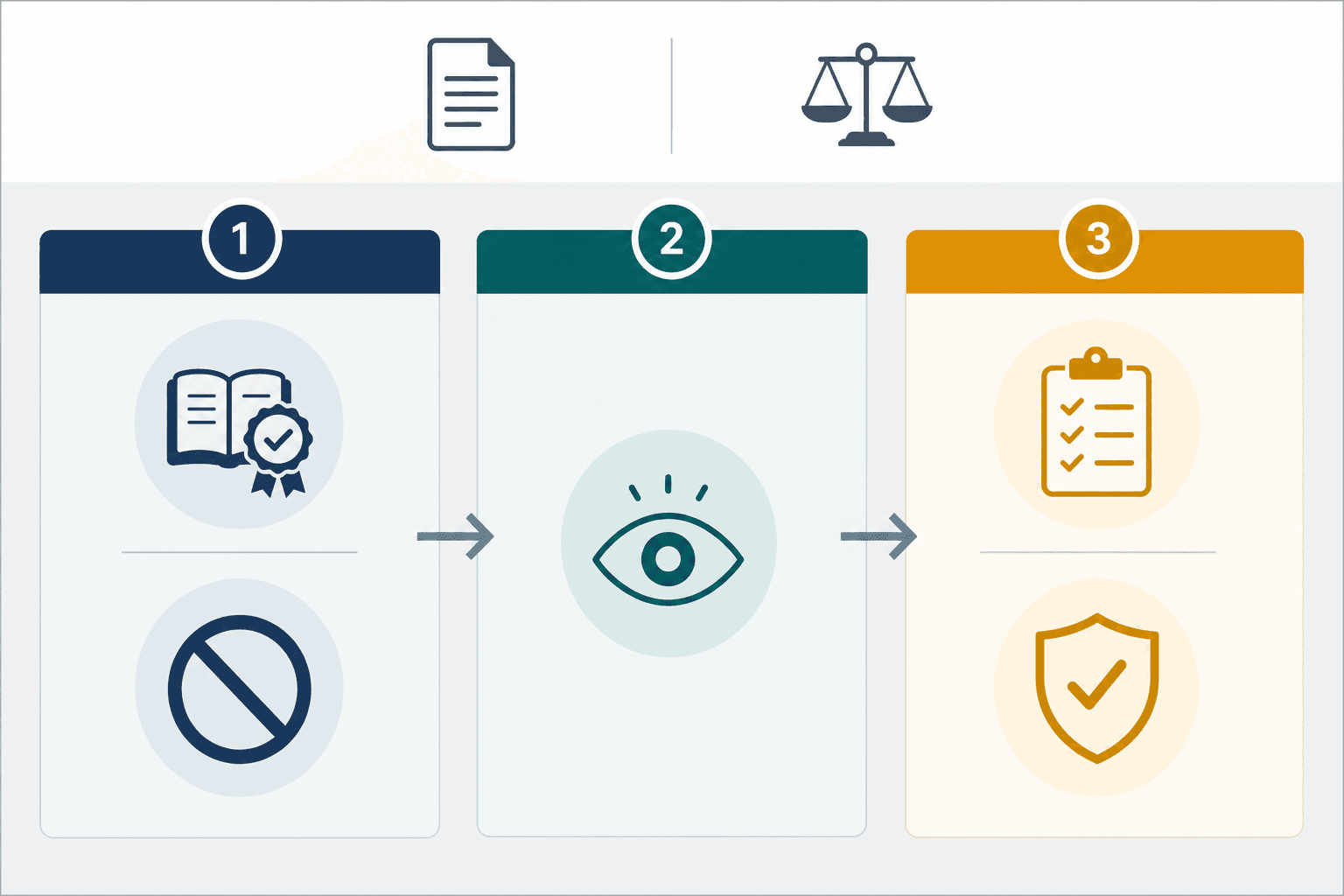
The phased timeline creates a structured preparation window. Legal organizations with EU operations or EU-client exposure should organize their compliance activity across three horizons: obligations already in force, obligations arriving in August 2026, and the full Annex III deployer compliance framework due by December 2027.
Now: In-Force Obligations Requiring Immediate Attention
- AI tool inventory and classification: Compile a complete inventory of AI systems in use across the organization. For each tool, assess whether the organization is acting as a provider or deployer, and whether the tool's use case is plausibly within Annex III scope. This inventory is the foundation for all subsequent compliance work.
- Article 5 prohibited-practice audit: Review each AI tool in the inventory against the Article 5 prohibited practices. Confirm that no tool in use engages in subliminal manipulation, exploits individual vulnerabilities, enables social scoring, or performs prohibited biometric identification. Document this assessment.
- AI literacy support programs: Establish or document programs that support adequate AI literacy among staff who use or oversee AI systems. The obligation does not require formal certification, but it requires deliberate organizational action — training programs, use-policy documentation, and oversight protocols all qualify.
- Vendor due diligence on GPAI obligations: Confirm that AI vendors supplying general-purpose AI models are meeting their GPAI obligations under Articles 51 through 56. Request documentation of their compliance posture as part of procurement or contract renewal.
Next: August 2026 — Article 50 Transparency Preparation
- Identify AI-generated content in client-facing outputs: Determine which client communications, documents, or deliverables incorporate AI-generated content. Article 50 requires that natural persons be informed when they are interacting with an AI system, and that AI-generated content be disclosed.
- Develop disclosure protocols: Draft and implement disclosure language for AI-generated content in client communications. Confirm that the firm's engagement letters, retainer agreements, or client-facing policies address AI use in a manner consistent with Article 50 requirements and applicable professional responsibility rules.
- Watermarking compliance for existing systems: If the firm uses AI systems that generate synthetic content — including AI-generated images, audio, or video — confirm vendor compliance with the Article 50(2) watermarking requirement. Existing systems have a proposed four-month grace period to December 2, 2026 under the Omnibus, but this grace period is subject to formal Omnibus publication.
Later: December 2027 — Full Annex III Deployer Compliance Framework
- Finalize high-risk AI system classification: Complete the Article 6(3) materiality assessment for each AI tool identified as potentially within Annex III scope. For tools where classification is uncertain, obtain the provider's documented assessment under Article 6(3). Seek qualified EU regulatory counsel for tools where the classification remains contested.
- Designate human oversight: Formally designate a competent person for human oversight of each high-risk AI system in use. Document their qualifications, training, authority, and support resources.
- Establish log retention infrastructure: Confirm that automatically generated logs from high-risk AI systems are preserved for at least six months. Coordinate with IT and vendors to implement technical log retention capabilities.
- Build incident reporting procedures: Develop and test procedures for identifying, escalating, and reporting serious incidents to providers and the relevant national market surveillance authority. Identify the competent authority in the relevant EU member state.
- Employee notification protocols: Develop and document notification procedures for informing employee representatives and employees who will be subject to high-risk AI systems before deployment.
- FRIA assessment (where applicable): Public bodies and private entities providing public services should conduct a Fundamental Rights Impact Assessment before deploying any high-risk AI system. Begin this assessment well in advance of the December 2027 deadline.
Penalties and Enforcement Risk Under Article 99
The EU AI Act's penalty structure is tiered by violation type and calibrated to organizational scale. For legal organizations, the relevant penalty levels under Article 99 are:
| Violation Type | Maximum Fine |
|---|---|
| Non-compliance with the Act's obligations (including Article 26 deployer obligations and Article 5 prohibited practices) | €30 million or 6% of global annual turnover for prohibited practices violations; €15 million or 3% of global annual turnover for other obligations violations — whichever is higher |
| Supplying incorrect, incomplete, or misleading information to national authorities | €7.5 million or 1% of global annual turnover — whichever is higher |
| Non-compliance by SMEs and start-ups | Lower of the monetary amounts specified above |
In addition to financial penalties, national market surveillance authorities have the power to require withdrawal of non-compliant AI systems from the EU market. For law firms and legal departments whose practices depend on specific AI tools, a market withdrawal order — even without a financial penalty — could be operationally disruptive.
Enforcement extraterritoriality for non-EU firms depends on practical factors: whether the firm has EU-based assets, personnel, or representatives; whether affected individuals are EU persons; and how national authorities choose to exercise their jurisdiction. The GDPR enforcement experience suggests that enforcement against purely non-EU entities without EU presence is possible but less common than enforcement against EU-established organizations. Non-EU firms with significant EU-client exposure should not treat the absence of an EU office as a reliable shield.
Comments
Join the discussion with an anonymous comment.